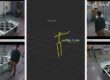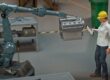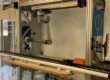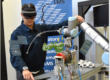


Nowadays, productivity is not anymore the only driver for the evolution of manufacturing. Companies pay more attention to the worksite analysis, hazard prevention and control, training and education for the employees. Moreover, a set of directives have been issued in Europe considering safety and health at work environment to improve the worker conditions, which in turn aims at reducing the risk of accidents to eventually create an appropriate environment with higher quality of life for workers.
This trend, named human-centred manufacturing, aims to define new social sustainable workplaces where the human dimension is a key cornerstone, highlighting the requirements for shifting from a traditional task-centric production to a worker-centric production [1].
Teamwork and added value tasks for manufacturing operators
In manufacturing, ergonomists would once study a single operator working at a single machine tool, with a focus on design of machine controls to improve both the worker health and work performance. They would have applied their knowledge drawn largely from anatomy and physiology.
However, manufacturing operators are members of a team and their skills are inevitably as cognitive and social, as much as physical. Therefore, they need to be able to understand quality control charts and maintenance procedures, as well as be able to reprogram to change the production schedule. Even when operating the process, operators use diagnosis and reasoning capabilities more than physical effort. Extended usage of ICT for cognitive automation and information sharing is becoming more common and increasingly important for factory workers.
Previous works and preliminary studies in human-centred manufacturing
During the last three years, MCM, Cembre and CNR-STIIMA worked together on the concept of human-centred manufacturing in the field of flexible machining.
Cembre has provided a manufacturing context requiring an extreme flexibility, with thousands of different part types in small and medium lots to be produced at the same time.
MCM and CNR-STIIMA made a joint effort to introduce collaborative robotics in Cembre’s manufacturing context, developing innovative ways for a cooperative robot and human activities’ planning, a novel user interface to support interaction between the robotic and human component of the solution and new metrics (Added Value Index) to estimate the benefits of introducing collaborative robots to support metallic prismatic parts loading/unloading.
From the conclusions of this preliminary study, it seemed that introducing collaborative robots could be economically sound not for a mere increase in performance (less time to execute tasks) but to shift repetitive human activities towards high-added value activities, directly relevant to increase production quality and workplace sustainability.
Sharework is aiming for a real interaction between automation and humans
With the cooperation of the Sharework consortium and its skills, MCM, CNR-STIIMA and Cembre’s efforts could lead to the application of collaborative robotics into real production assembly lines.
The industry needs new automation technology capable of interacting and cooperating with factory workers. Collaborative robots and automated guided vehicles are examples of devices that can already share the space with human workers. In Sharework project, we should make their activities not only compatible but deeply integrated with human activities.
The goal is not new, and I would like to use the words of Judea Pearl at the IJCAI 1999 conference to describe it:
“We must build machines that make sense of what goes on in their environment, so they can recover when things do not turn out exactly as expected. And we must build machines that understand … when we have the time to teach them what we know about the world”[2].

Giuseppe Fogliazza
Director Machining Centers Engineering S.r.l.
Graduated in Pisa in Information Sciences, he started the collaboration with MCM S.p.A., a company that realizes machining centers and flexible production systems, with the task of developing its supervision software. Since 1994 he has been responsible for MCM for relations with academia, and for the coordination of research activities. In this role he has coordinated the participation of MCM in various national and European research projects. Giuseppe is the Director of Machining Centers Engineering S.r.l., a software division of MCM S.p.A., which with a staff of 15 people develops software services to support manufacturing production and factory integration.
References
[1] Gökan May, Marco Taisch, Andrea Bettoni, Omid Maghazei, Annarita Matarazzo, Bojan Stahl, A new Human-centric Factory Model, 12th Global Conference on Sustainable Manufacturing
[2] Judea Pearl, Transcript and slides of 1999 IJCAI Award Lecture: Reasoning with Cause and Effect